


As the world has continued to feel like it’s coming apart at the seams, I’ve seen simultaneous increases in both vague calls to action (Get involved! Build community! Call your representatives!) and in people experiencing high rates of exhaustion, overwhelm, and burnout. More and more I’m being asked the question: “What can I do that will actually help? How can I make a difference that I can see? How will I know that the work I’m doing will mean something?”
So I think it’s prudent that we spend a little time together talking about both high-impact actions AND digging a little deeper into the unmet needs pushing us towards asking this question in the first place.
Before we get into actions, here are a few Great Queer News stories from this week that deserve to be celebrated!
The Trump admin has dropped their appeal (thus ending the case) of a lower court ruling against their attempts to force schools to remove anything that could be labeled “DEI” from their curriculum or policies. The demands cannot be enforced against any school in America! (More: Democracy Forward)
Democrats have successfully stripped ALL ANTI TRANS RIDERS out of the federal budget!! This is almost certainly in large part thanks to regular people like us calling our elected officials to let them know WE CARE!! (More: Erin in the Morning)
The latest hearing on Trump’s military ban was last week, and what was expected to be a quick hearing turned into three hours of grilling the administration about their intent with the ban. This bodes well!! (More: The Advocate)
Six CHLA families sued the Trump administration and blocked the release of patient data for over 3,000 families. (More: Erin in the Morning)
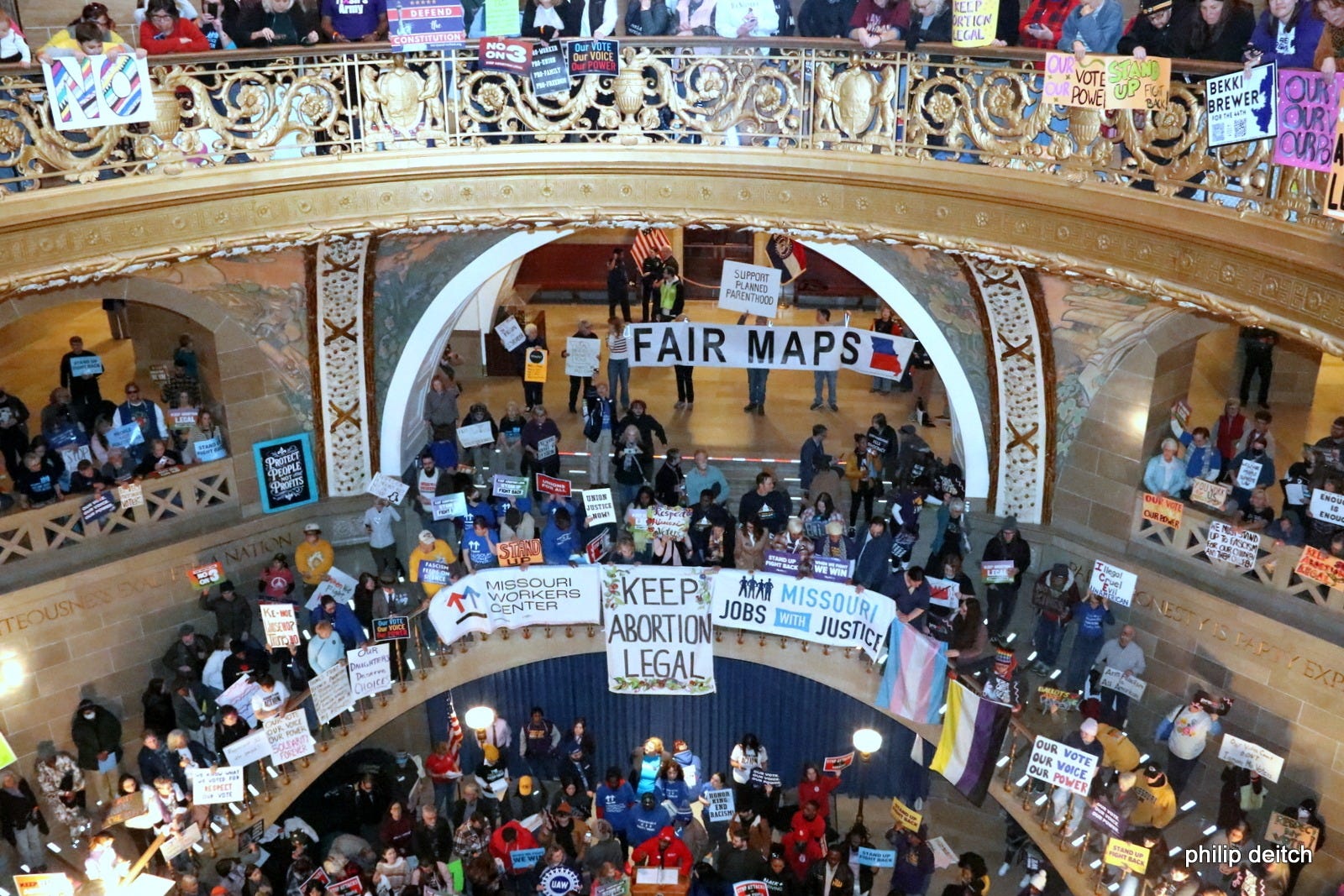
Something else that brought me tremendous hope: Last week, over a thousand Missourians across movements—racial justice, immigrant rights, voting rights, body autonomy, workers rights, and more— joined together to force legislators to hear their voices.
I say this with both extreme gentleness and the firmness that the moment requires: If you are someone sitting on the sidelines and assuming there is something that fundamentally differentiates those who are taking action right now from those who aren’t, you will not find one here. The people you are seeing are not only career organizers or trained advocates, but everyday people deciding enough is enough and being willing to do something about it. Everyday people being brave enough to go to the capital for the first time. Everyday people protecting their neighbors in Minneapolis. Everyday people deciding to call their elected official every day. Everyday people figuring out what they can do best to make a difference.
Want to support my work? Consider buying me a virtual coffee!
The theme of this week is PEOPLE POWER.
So how do I make a difference I can see?
I get asked this question a lot. I intended to write this article weeks ago, but I found myself running into a wall over and over again. Finally I realized why: I didn’t know how to put together a list of actions to answer that question because I knew that wasn’t actually the need that was going unmet. Sure, the actions will be helpful, but I want to try to pair those actions with some important reminders.
First important reminder: Delayed gratification is a muscle that, for many of us, has atrophied. I can get my package delivered the same day I order it. I can pay an extra 3 dollars to get my food delivered within the hour. As we build up entire economies of convenience and of instant payoff, it becomes increasingly uncomfortable to do things that don’t have an immediate effect.
But actions that add up while having no immediate positive feedback—like calling your elected officials—are crucial. Take a look at some of the recent results of the flood of calls relating to the absolute horror of ICE’s behavior (and existence):

The highlights for skimmers: democrats are changing their stances. REPUBLICANS are changing their stances. The sponsor of the bill that all these calls are protesting changed her mind and voted against her own bill. Your calls are literally tallied, and they are adding up.
Action you can see: download the app 5 calls. If you’re feeling nervous about calling your legislators, know that the first call is often the most frightening. The app will give you phone numbers, scripts, and encouragement to make phone calls about things you’re passionate about. Watch your efforts add up.
Feeling: So many people are getting hurt
For some people, they’re asking for actions they can see because the pain of the people in the world is starting to feel overwhelming. Doesn’t anybody care? Can’t we just help each other?
If you’re feeling acutely aware of the suffering of your community, the best response is to get acutely involved in the healing of your community through local direct services and mutual aid efforts.
Ideas for you:
Go to gofundme and search for “transition surgery” or something similar. Pick a random person who is either close to their goal or has $0. Make the biggest donation you can. Sometimes, I like to pick people where I can pay off the entire rest of their goal anonymously.
Look up “mutual aid” + your city to find what support networks already exist (this website might have one for your area: ) and then sign up for a volunteer shift
One of my favorite things in the world is Erin Reed’s annual round up of trans girl scouts to buy cookies from. Get yourself some thin mints. Double your impact and buy boxes to donate to a trans community center!
If ICE has arrived in your city, there is a very good chance that your immigrant and latiné neighbors do not feel safe leaving their homes. Look up local grocery delivery or companionship efforts to help them not feel so alone right now.
Reminder: At any given moment in history, a lot of people are hurting. The biggest difference now is that social media has given us constant and unrelenting insights into how much they are hurting. It is beautiful for humans to be so connected to each other, and past a certain point exposing yourself constantly to that pain will sap out every ounce of energy you have. To hold someone in their pain is a gift to give to them, but it is not free. Consider being more intentional about setting up boundaries and barriers to doomscrolling.
Feeling: Everything is getting worse
Reminder: It is not a coincidence that the sources making us feel like it’s time to give up (news, social media, hateful politicians) are the same people with a critical vested interest in us believing them. They don’t want you to win, so they don’t want you to try. Intaking high levels of news without taking any actions is shown to have devastating impacts on mental health. Give yourself permission to know less to do more. Pushing through the discomfort to start taking actions that feel doable to you is the only way to make this feel better.
There are a lot of things that might feel like they’re getting worse, so here are a few starter examples of immediate actions you can take based on things that feel particularly scary to you:
Book Bans:
Every week, pick a different queer book by a queer author. Leave a positive review online. Reach out to the bookstores and libraries around you to ask them to stock that book (they care a lot more about requests from their own community members, and your library probably has an online form or email you can use to request books!)
Everyone is getting angrier:
“Adopt” a local queer business. Become a regular. Learn the names of the folks working there. Make it a mission to bring one new person there every month. Regular patronage will help recirculate money through supportive businesses and your local economy. Leave a BIG ASS TIP.
Consider getting trained in deep canvassing, one of the most incredible and effective ways to change people’s minds one at a time, person to person, on the ground. https://www.ourgroundtruth.org/
Political attacks on trans people:
Sign up for action updates from your state-level advocacy organization. Listen to them!!
Join a local PFLAG chapter, many of which are scaling up their efforts to get involved in local advocacy and support campaigns. If you have specific skills you want to put to use, reach out and offer them!
I’m so frightened for the people I love
I hear you! It’s a frightening time. Rather than waiting for our loved ones to ask for help, we’re going to be proactive and enthusiastic.
What is your favorite thing to do, or to do for other people? A favor that’s particularly easy or fun for you?
Pick a few people in your life and offer that specifically.
Do you want to go for a walk together this weekend?
What if we picked a recipe and cooked together on facetime?
I made too much food—can I drop some off at your house?
I’m in the mood to break out my toolbox. Do you have anything that needs fixing?
I’m listening to a great new audiobook while I run errands later. Any stops I can add for you?
If you need more ideas here, check out my article with a very long list of ideas to add to your support menu!

In Sum
The world as we know it is engineered to make us feel overstimulated, overwhelmed, exhausted, disconnected, etc. I’m not the first to write this. It makes sense that many of us are feeling disempowered or disheartened, but the only antidote to this is finding our way to action and, thus, to empowerment.
I know it is not fun to hear. But we cannot self care our way out of this one. Self care will be crucial for keeping our energy restored so we feel safe enough to act, but that pit you feel in your stomach? That looming hopelessness? That doesn’t go away until we start to find something we can do about it.
We are coming up against problems that were built by thousands of people with billions of dollars over hundreds of years. One person was never going to fix it—meaning the perfection or mistakes of your individual actions doesn’t actually matter. Instead, it is going to take every single one of us passing the torch, sharing the load, and doing what we can wherever we can.
But if we do it together, I know we’ll be able to get there. Give yourself some grace, give yourself some love, and tell yourself it’s time to get to work.
Any actions I missed? Share your favorite one in the comments!
All my love as always,
Ben
Sooooo many great nuggets in here, Ben! Dang. TY for compiling this and keeping our nervous systems in check. Much love and coffee.
"I am no longer accepting the things I cannot change. I am changing the things I cannot accept."
— Angela Davis
Life Survival: On Accepting vs. Changing
Davis wrote this after watching too many people confuse serenity with surrender. Right now the regime wants you to "accept" that the Fed answers to Trump, that climate agreements are optional, that federal agents can murder citizens with impunity. Fuck that. The things you cannot change are the hand you're dealt—being alive during democratic collapse, watching institutions bend. The things you cannot accept are the outcomes they're pushing—unchecked executive power, planetary suicide, state violence. The trick is knowing which is which. You can't change that Trump's in office. You can refuse to accept what he does with it. You can't change that Pride Month saw 268 attacks. You can change how your community responds. The survival move is learning to hold both—the grief of what's happening and the refusal to normalize it.
https://thistleandmoss.com/p/this-week-is-shaping-up-kind-of-better